

Smart First Aid Kits Market is expected to reach US$ 190.81 Million by 2033 | DataM Intelligence
Smart First Aid Kits Market
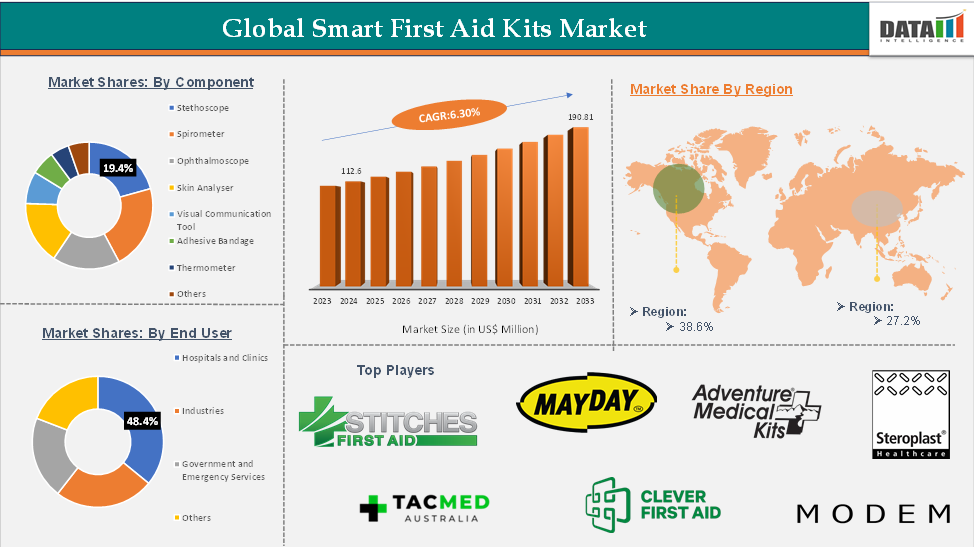
Smart First Aid Kits Market is expected to reach at a CAGR of 6.3% during the forecast period 2025-2033.
The Smart First Aid Kits Market is gaining traction as IoT, AI, and connected health devices enhance emergency response, workplace safety, and real-time health monitoring across sectors.”
AUSTIN, TX, UNITED STATES, February 6, 2026 /EINPresswire.com/ -- Market Overview:— DataM Intelligence
The Smart First Aid Kits Market is emerging as a vital segment within the broader healthcare and safety ecosystem, driven by the convergence of digital health technologies, IoT-enabled medical devices, and growing awareness around emergency preparedness. Unlike traditional first aid kits, smart first aid kits integrate sensors, connectivity, mobile applications, and real-time guidance features to deliver timely and effective medical assistance during emergencies. These kits are increasingly being adopted across households, workplaces, educational institutions, industrial facilities, and travel settings, as they offer automated inventory tracking, usage alerts, and in some cases, AI-powered injury assessment and response recommendations. As safety compliance standards tighten and consumers become more health-conscious, smart first aid kits are transitioning from optional accessories to essential safety tools.
To Download Sample Report Here: https://www.datamintelligence.com/download-sample/smart-first-aid-kits-market
According to DataM Intelligence, The Global Smart First Aid Kits Market was valued at approximately USD 112.6 million in 2024 and is projected to reach around USD 190.81 million by 2033, growing at a CAGR of nearly 6.3% during the forecast period (2025–2033). Key growth drivers include the rapid adoption of connected healthcare devices, rising workplace safety regulations, increasing incidence of accidents and medical emergencies, and growing penetration of smartphones and mobile health applications. The homecare and workplace safety segment currently dominates the market due to high demand for automated and easy-to-use emergency solutions, while North America leads geographically, supported by advanced healthcare infrastructure, strong regulatory enforcement, and early adoption of smart medical technologies across corporate and residential settings.
Key Highlights from the Report:
The Market is witnessing strong growth due to rising integration of IoT and mobile health technologies in emergency care solutions.
Smart inventory management and automated alerts are transforming compliance and safety management practices.
Workplace and industrial safety applications represent the leading end-user segment globally.
North America remains the dominant regional market due to high technology adoption and regulatory awareness.
Asia-Pacific is expected to record the fastest growth rate during the forecast period.
Continuous product innovation, including AI-enabled guidance and cloud connectivity, is intensifying market competition.
Market Segmentation Analysis:
The Smart First Aid Kits Market is segmented based on product type, end-user, and connectivity technology, each contributing uniquely to overall market expansion. By product type, the market includes basic smart kits with digital inventory tracking, advanced smart kits with sensor-based monitoring, and premium AI-enabled kits offering real-time guidance through connected applications. Advanced and AI-enabled smart first aid kits are gaining traction as they provide step-by-step emergency instructions, expiry alerts for medical supplies, and integration with emergency response systems, making them highly valuable in critical situations.
Based on end-user, the market is segmented into households, workplaces, educational institutions, healthcare facilities, travel and tourism, and public spaces. Workplaces and industrial environments account for a significant share due to strict occupational safety regulations and the need for compliance-ready emergency solutions. Meanwhile, the household segment is expanding steadily as consumers seek smarter and more reliable health and safety products for everyday use. Educational institutions and public infrastructure facilities are also adopting smart first aid kits to enhance preparedness and response capabilities.
In terms of connectivity, the market is categorized into Bluetooth-enabled, Wi-Fi-enabled, and cloud-connected smart first aid kits. Cloud-connected kits are witnessing growing demand as they enable centralized monitoring, real-time data access, and seamless integration with enterprise safety management systems. This segmentation reflects the market’s shift toward scalable, data-driven emergency care solutions that go beyond basic first aid functionality.
Speak to Our Analyst and Get Customization in the report as per your requirements: https://www.datamintelligence.com/customize/smart-first-aid-kits-market
Regional Insights:
North America holds the largest share of the smart first aid kits market, driven by strong awareness of workplace safety, high healthcare spending, and rapid adoption of connected medical devices. The presence of established market players, favorable reimbursement frameworks for digital health tools, and strict regulatory standards further support regional growth. The United States, in particular, leads in terms of innovation and deployment of smart emergency care solutions across corporate offices, factories, and residential complexes.
Europe represents a mature market characterized by stringent occupational health and safety regulations and increasing adoption of smart safety equipment across industries. Countries such as Germany, the United Kingdom, and France are witnessing steady demand for smart first aid kits, especially in industrial and public infrastructure applications. The region’s focus on preventive healthcare and digital transformation supports sustained market expansion.
The Asia-Pacific region is expected to witness the fastest growth during the forecast period, fueled by rapid urbanization, expanding industrial activities, and rising awareness of emergency preparedness. Countries like China, Japan, India, and South Korea are investing in smart healthcare infrastructure and workplace safety solutions, creating lucrative opportunities for market players. Growing smartphone penetration and improving internet connectivity further enhance the adoption of app-enabled smart first aid kits in the region.
Market Dynamics:
Market Drivers
The primary driver of the smart first aid kits market is the growing demand for technologically advanced emergency response solutions that improve safety outcomes. Increasing workplace accidents, road incidents, and health emergencies have highlighted the limitations of conventional first aid kits. Smart kits address these gaps by providing real-time guidance, automated monitoring, and compliance support. Additionally, the rising adoption of IoT and mobile health technologies across healthcare and safety domains is accelerating product innovation and market penetration.
Market Restraints
Despite strong growth potential, the market faces certain restraints, including higher costs compared to traditional first aid kits. Price sensitivity in developing regions can limit adoption, particularly among small businesses and households. Data privacy and cybersecurity concerns related to connected devices also pose challenges, as smart first aid kits often collect and transmit sensitive health-related information. Furthermore, lack of standardized regulations for smart emergency devices may slow large-scale adoption in some regions.
Market Opportunities
The market presents significant opportunities through technological advancements and untapped emerging markets. Integration of artificial intelligence, voice-assisted guidance, and predictive analytics can further enhance the value proposition of smart first aid kits. Expansion into developing economies, supported by government safety initiatives and growing digital infrastructure, offers substantial growth potential. Partnerships between technology providers, healthcare companies, and safety solution vendors are also expected to unlock new revenue streams and accelerate innovation.
Looking For Full Report? Get it Here: https://www.datamintelligence.com/buy-now-page?report=smart-first-aid-kits-market
Frequently Asked Questions (FAQs):
How big is the global Smart First Aid Kits Market in terms of value?
Who are the key players in the global Smart First Aid Kits Market?
What is the projected growth rate of the Smart First Aid Kits Market during the forecast period?
What is the market forecast for smart first aid kits through 2033?
Which region is estimated to dominate the Smart First Aid Kits Market over the forecast period?
Company Insights and Competitive Landscape:
The Smart First Aid Kits Market is moderately competitive, with players focusing on innovation, product differentiation, and strategic collaborations to strengthen their market position. Key players operating in the market include:
Clever First Aid
Modem Works B.V.
Adventure Medical Kits
TacMed Australia
Mayday Industries
Stitches First Aid
Steroplast Healthcare Limited
Recent Developments:
United States:
January 2026: US healthcare providers began piloting smart first aid kits with integrated telemedicine features, allowing remote vital sign monitoring during emergencies. These kits connect directly to physician apps for faster triage in rural clinics.
December 2025: A major US industrial safety firm launched IoT-enabled smart kits for warehouses, featuring real-time inventory alerts and automated reorder systems to ensure OSHA compliance.
November 2025: American tech startups introduced compact smart kits for schools with AI-driven injury assessment tools, providing voice-guided first aid steps tailored to pediatric cases.
October 2025: US disaster response agencies adopted smart first aid stations in public venues, incorporating GPS-enabled supply tracking and emergency beacon activation for mass casualty events.
Japan:
January 2026: A Japanese electronics manufacturer unveiled a smart first aid kit with voice-guided multilingual emergency instructions, aimed at households and elderly care facilities.
December 2025: Japanese industrial safety firms deployed IoT-enabled first aid stations across manufacturing sites for automated stock monitoring and compliance reporting, integrated with facility systems.
November 2025: A Japan-based healthcare tech company launched compact smart first aid kits with sensor-based expiration tracking, targeting urban homes and offices to prevent use of expired supplies.
October 2025: Japan's disaster-preparedness initiatives adopted digitally assisted first aid kits for public spaces, featuring mobile guidance and emergency contact integration for rapid earthquake response.
Unlock 360° Market Intelligence with DataM Subscription Services: https://www.datamintelligence.com/reports-subscription
Conclusion:
The Smart First Aid Kits Market is undergoing a significant transformation as digital technologies redefine emergency preparedness and response. With strong growth drivers such as increasing safety awareness, technological innovation, and regulatory compliance requirements, the market is poised for robust expansion over the coming years. While challenges related to cost and data security persist, continuous innovation and expanding adoption across residential, commercial, and industrial sectors are expected to outweigh these limitations. As smart healthcare and safety solutions become more mainstream, smart first aid kits will play an increasingly critical role in enhancing safety outcomes and saving lives worldwide.
Related Reports:
Medical Thermometer Market
Electronic Stethoscope Market
Sai Kiran
DataM Intelligence 4Market Research
+1 877-441-4866
Sai.k@datamintelligence.com
Visit us on social media:
LinkedIn
X
Legal Disclaimer:
EIN Presswire provides this news content "as is" without warranty of any kind. We do not accept any responsibility or liability for the accuracy, content, images, videos, licenses, completeness, legality, or reliability of the information contained in this article. If you have any complaints or copyright issues related to this article, kindly contact the author above.
